The associated biodiversity benefits of a solar farm can help garner local support. In the second of this week’s PV Tech Premium pieces, Tom Kenning looks at the emerging scientific understanding of PV’s ecological impacts.
Understanding the effects on land and biodiversity caused by land-based renewables is far from straightforward. The outcomes range significantly depending on the specifics of any given piece of land, its original level of biodiversity and how it was used prior to the PV system being installed.
Try Premium for just $1
- Full premium access for the first month at only $1
- Converts to an annual rate after 30 days unless cancelled
- Cancel anytime during the trial period
Premium Benefits
- Expert industry analysis and interviews
- Digital access to PV Tech Power journal
- Exclusive event discounts
Or get the full Premium subscription right away
Or continue reading this article for free
While some argue that solar farms harm agricultural land, others claim they improve soil health. Indeed, the conversation around solar farms often lacks reliable data, leading to conflicting narratives. Scientists such as Alona Armstrong, professor in energy and environmental sciences at Lancaster University in the UK and director of the university’s Energy Lancaster research group, are working to provide solid data on the environmental trade-offs.
Armstrong’s team has digitised nearly all UK solar farms to quantify how much land they take up, how they are distributed throughout the country and the changes in land take through time. They also quantify how much land would be required for various projected PV targets, although the land area depends on the proportions assumed to be deployed as solar farms, on buildings and water bodies. The team is also assessing impacts from soil to pollinators, and how site management may alter the consequences.
Science over opinion
“There are a lot of voices on the land areas converted to solar farms and the impacts on nature, and not all of it is right or applies to every location given the importance of the local context. A scientific evidence base is critical to inform outcomes and reduce controversy,” says Armstrong, while highlighting that there will be trade-offs.
One key biodiversity consideration is how the land was used before solar panels were installed. Many voices malign the loss of agricultural land to solar energy, but agriculture itself can be a major cause of biodiversity and habitat loss.
For example, compared to conventional farmland, solar farms have been found to increase both the diversity and abundance of some plants, invertebrates and birds, as shown in a pioneering study carried out by Clarkson & Woods and Wychwood Biodiversity in 2016.
In contrast, if land was already managed for biodiversity, then solar developments might disrupt an existing ecosystem.
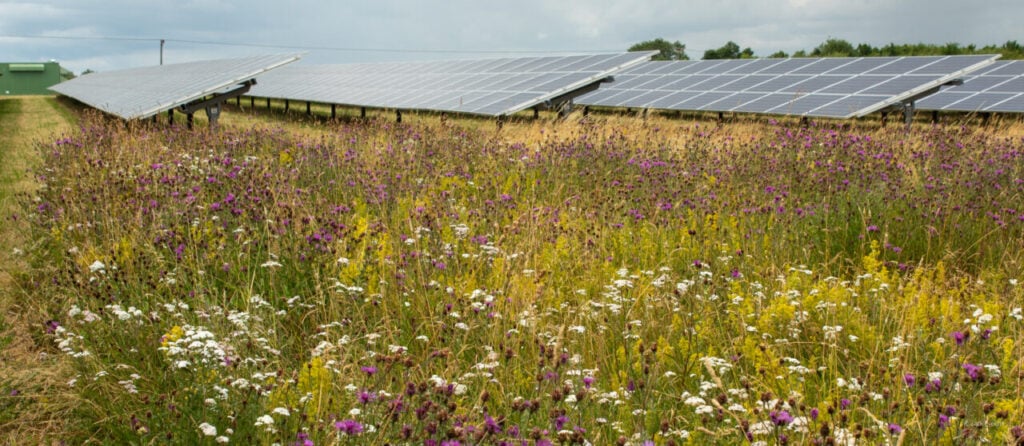
Nonetheless, properly managed solar farms can foster wildlife, offering shelter and food sources especially when cultivated into a well-functioning meadow with a species-rich mix of plants.
“We need land for food production, but intensive agriculture is associated with biodiversity loss,” Armstrong adds. “Converting intensively managed agricultural land into a solar farm and actively managing it for biodiversity can have net positive outcomes for biodiversity but it will reduce food production. There is no easy answer – we need food, we need low carbon energy, we need space for nature. As we move towards net zero, there will be trade-offs, so decisions need to be based on scientific evidence.”

The ecologist’s view
“You want to tailor management to suit the local context and desired outcomes, be that pollinators, birds, or soil carbon sequestration,” advises Hannah Montag, associate director of Clarkson & Woods.
However, data is still needed on how flowers behave under the shade of solar panels, though Guy Parker, director of Wychwood Biodiversity, notes that there is less flowering under the arrays because of the darker conditions. On the other hand, Californian researchers are looking into how sheltering under solar panels can be used to mitigate heat stress on cattle.
Measures such as planting wildflowers, maintaining hedgerows and allowing controlled grazing can enhance biodiversity and add to the multi-functionality of a plot in a land-constrained country. Indeed, solar farms can increase local pollinator populations or boost pollination of nearby crops. Wildflower meadows – a valuable habitat in their own right – can also support bumblebee foraging and nesting.
Moreover, it doesn’t necessarily need to cost more to manage well for biodiversity.
“There are some easy wins, like hedges,” says Parker. “It’s better for biodiversity if you cut them every two to three years instead of annually, and it’s also cheaper.”
However, results take time, warns Armstrong, adding: “Soils are really slow to respond, and the oldest UK solar farms are roughly 10-12 years old. So, if you’re looking for a change in soil carbon, it’s unlikely you’ll see it yet.”
Nor is it all good news. Bats, for example, may find foraging for insects more difficult in solar farm locations and a PV system’s effect on the soil’s capacity to store carbon is still unknown. However, Montag suggests that in the future, the design and management of solar arrays could be adapted to minimise detrimental and enhance desirable outcomes.
Armstrong’s team have also considered how appropriate public policies that link net zero targets with nature recovery could steer solar farm management towards enhancing biodiversity. As regulations evolve and the industry matures, she hopes that every solar farm will be located, built and managed in a way that embeds biodiversity benefits.