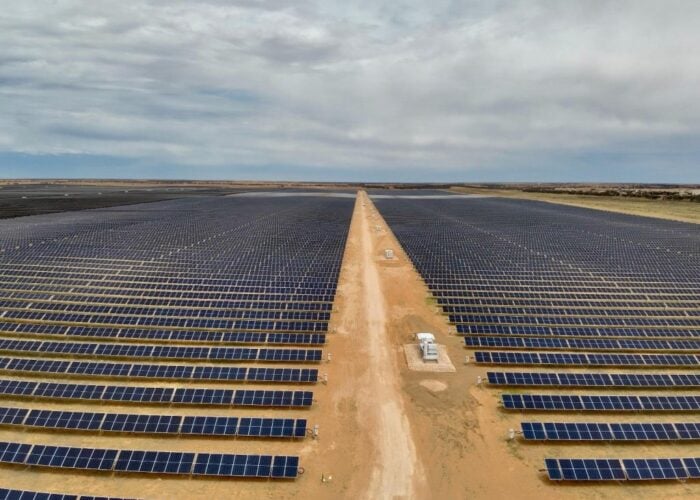
Australia needs to build nearly 120GW of utility-scale wind and solar by 2050, approximately five times the current level of around 23GW, according to the 2026 Integrated System Plan (ISP) published by the Australian Energy Market Operator (AEMO).
The ISP sets out AEMO’s least-cost roadmap for the National Electricity Market (NEM) through to 2050 and reaffirms that renewable energy, firmed with storage, backed by flexible gas and connected through upgraded transmission networks, remains the lowest-cost pathway as coal-fired generation retires.
Try Premium for just $1
- Full premium access for the first month at only $1
- Converts to an annual rate after 30 days unless cancelled
- Cancel anytime during the trial period
Premium Benefits
- Expert industry analysis and interviews
- Digital access to PV Tech Power journal
- Exclusive event discounts
Or get the full Premium subscription right away
Or continue reading this article for free
Under the Optimal Development Path (ODP), renewable energy would achieve Australia’s 82% national target by 2030 and deliver 98% of generation by 2050, with most of the NEM’s remaining coal fleet withdrawn by 2038 and all coal exiting by 2049.
AEMO CEO Daniel Westerman said the direction is clear.
“Renewable energy, firmed with storage, backed up by gas and connected with upgraded networks, remains the least-cost roadmap to meet Australia’s energy needs,” Westerman said.
“The planning for this larger and more complex system is clear. The focus now is firmly on delivery.”
From 23GW to 120GW: the scale of the task
The scale of the solar and wind buildout implied by the ISP’s Optimal Development Path is striking.
Australia’s grid-scale renewables fleet stood at approximately 23GW at the start of 2026, with around 34GW of total grid-scale renewables and batteries operating in the NEM.
Reaching 120GW of utility-scale wind and solar by 2050 requires sustained deployment of new capacity at a rate that has not yet been achieved in any consecutive five-year period.
The ISP models three scenarios, Step Change, Slower Growth and Accelerated Transition, and selects the ODP as the pathway that minimises cost across all three.
In the Step Change scenario, which AEMO assigns a 46% probability, the ODP requires AU$106 billion of investment to 2050 across utility-scale generation, storage, firming and network infrastructure. Grid-scale wind and solar represent the largest single component of that investment.
The share of renewable energy in NEM generation has already risen sharply, as documented throughout PV Tech Premium’s NEM Data Spotlight series.
Renewables met around 45% of all demand for electricity in the NEM in the 2026 financial year, exceeded 50% in the December quarter of 2025, and reached close to 80% for a single half-hour period on 11 October 2025.
These records are themselves the product of a buildout that has tripled renewable energy delivery in the NEM over the past decade.
The ISP is explicit that the pace of generation delivery needs to accelerate further. AEMO modelled a constrained delivery scenario in which generation and transmission projects take longer and cost more than planned.
In that scenario, achieving some 2030 policy targets would be delayed, and consumer benefits would be eroded. The analysis confirmed the ODP’s choice of projects is robust to those delays but underscored that progress cannot slow.
Rooftop solar as a parallel system
The 120GW utility-scale figure sits alongside a parallel consumer-led solar deployment that the ISP treats as an increasingly central part of the generation mix. Already, 36% of suitable dwellings in the NEM have rooftop solar installed.
The ISP forecasts that the figure will rise to 56% by 2050, with consumers collectively holding 87GW of rooftop and small-scale solar by then.
Consumer resources combining rooftop solar, batteries and coordinated demand management already met a record of just over 60% of NEM energy demand on 4 October 2025.
The ISP finds that if half of all household batteries respond to market signals through virtual power plants (VPPs), the system would save approximately AU$7.2 billion (US$4.96 billion) in avoided grid-scale investment, one of the more consequential findings for the distributed solar and storage industry.
The interaction between rooftop solar and grid demand is also reshaping the load profile the utility-scale fleet must serve.
Household grid-supplied energy needs are forecast to fall by 44% to just 20TWh by 2050, despite more electric vehicles (EVs) and appliances, as solar self-consumption reduces net grid purchases.
Business and industry, by contrast, are forecast to nearly double their grid electricity consumption to 280TWh by 2050, driven by electrified processes, data centres and green industrial production.
Storage and transmission as enabling infrastructure
The 120GW renewable energy target cannot be delivered without parallel investment in firming and network infrastructure to make variable generation dispatchable.
The ISP’s storage requirements, covered in depth by our sister publication, Energy-Storage.news, call for 35GW of short and medium-duration battery storage for daily firming and 5GW of long-duration storage for seasonal reliability, alongside 17GW of flexible gas and 6,000km of new transmission to connect renewable energy from high-resource areas to demand centres.
Transmission investment in the ODP is projected to deliver AU$28 billion in net market benefits to consumers, comprising AU$26 billion in avoided system costs and AU$2 billion in emissions reduction value. The ISP is explicit that this transmission should be delivered without delay.
Modelling showed that delayed transmission increases costs even as generation delivery also slows, meaning the two must advance together rather than sequentially.
The renewable energy zones that underpin the 120GW buildout are already producing results. Around 34GW of grid-scale renewables and batteries were operating in the NEM at the start of 2026, with a further 67GW of projects progressing through the connections process.
Of that 67GW, 45GW are grid-scale battery storage projects, reflecting the degree to which private capital has already concluded that solar and wind-plus-storage is commercially viable without waiting for the ISP to mandate it.
Delivery as the defining challenge
The ISP’s most consistent message is that the planning work is done. The challenge is delivery.
Australia’s construction pipeline for large-scale solar and wind has expanded rapidly through successive rounds of the Capacity Investment Scheme (CIS), but the gap between projects in the probable queue and projects that reach final investment decision remains wide.
The Clean Energy Regulator’s pipeline data for May 2026 showed a probable queue of 32GW against a committed queue of just 7.3GW, a ratio that reflects how much of the 120GW target still depends on projects converting from planning to construction at a pace the market has not yet sustained.
“While momentum in investment and delivery continues to build, challenges remain in delivering essential infrastructure at the pace required. Slower progress will erode benefits to consumers and present risks to reliability,” Westerman said.
For Australia’s solar industry, the ISP’s 120GW figure sets the destination. Whether the construction and supply chain machinery to reach it can be assembled in time is the question the next decade of delivery will answer.
Parts of this article, including the two graphs, were first published on our sister site, Energy-Storage.news, under the item ‘Australia: AEMO calls for 35GW of short and medium-duration storage plus 5GW of long-duration storage by 2050‘.