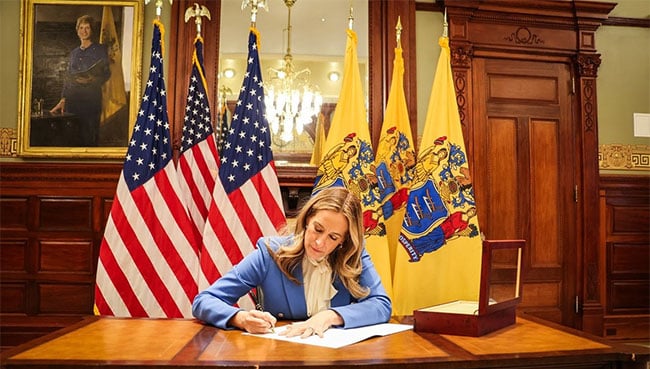
New Jersey governor Mikie Sherrill has signed into law a bill that will permit state residents to use plug-in solar panels of up to 1,200W.
The Garden State Balcony Solar Act passed the state legislature in July, and received near-unanimous support from both the New Jersey Senate and Assembly, with no votes against and just one abstention across both chambers of government.
Try Premium for just $1
- Full premium access for the first month at only $1
- Converts to an annual rate after 30 days unless cancelled
- Cancel anytime during the trial period
Premium Benefits
- Expert industry analysis and interviews
- Digital access to PV Tech Power journal
- Exclusive event discounts
Or get the full Premium subscription right away
Or continue reading this article for free
“Balcony solar is a practical, easy-to-use tool that can help families save money while allowing more people to participate in our clean energy future,” said Sherrill. “This bill cuts unnecessary red tape, expands access to affordable solar power, and proves that affordability and sustainability can go hand in hand.”
The passage of the bill follows the advancement of similar bills in a number of states, including California, Colorado and Maine.
Access to electricity generation beyond the PJM grid
The New Jersey bill also does not include a provision that residential customers secure approval from a utility prior to installing a plug-in solar system, a key component of the bill that will help facilitate energy security for homes outside of conventional grid infrastructure.
This is particularly significant in New Jersey, which is part of the PJM grid network in the north-east US. In April, PJM started its first grid application process under a ‘first-ready, first-served’ approach, which differs from the old ‘first-come, first-served’ approach that had led to significant delays in securing grid connection.
However, the new application process, in which applicants must demonstrate that they own the site on which they intend to build electricity generation projects and make “meaningful up-front financial commitments”, has led to a significant capacity of fossil fuel applications. Of the 220GW of capacity applied for in the first round of the new bidding process in April, natural gas projects accounted for 105.8GW, with nuclear accounting for a further 17.9GW. While the new rules may not explicitly seek to exclude renewable energy projects from the grid, the results are striking; solar accounted for just 14.8MW of capacity applications earlier this year.
As a result, it could be to the benefit of the New Jersey solar industry as a whole if homeowners are able to install plug-in solar independently from PJM and its operating process.
“The Garden State Balcony Solar Act fundamentally changes the relationship that New Jersey renters, apartment dwellers, and low-income families have with solar—expanding access to local clean energy, bill savings, and agency in where our energy comes from,” said Elowyn Corby, senior regional director for the Mid-Atlantic at Vote Solar, an advocacy group that was in favour of the bill.
“With today’s signing of the Garden State Balcony Solar Act, New Jersey is building a future where everyone can take part in the clean energy transition. “We are proud to see New Jersey adopt forward-thinking solutions that help lower energy bills and create a cleaner and more equitable future for all.”